






© 2007 Created by Goqa




The field selected for the observations needed to fulfil several criteria. It had
to be at a high galactic latitude, because dust and obscuring matter in the plane
of the Milky Way's disc prevents observations of distant galaxies. The target field
had to avoid known bright sources of visible light (such as foreground stars), and
infrared, ultraviolet and X-
These criteria considerably restricted the field of potential target areas. It was
further decided that the target should be in Hubble's 'continuous viewing zones'
(CVZs)—the areas of sky which are not occulted by the Earth or the moon during Hubble's
orbit. The working group decided to concentrate on the northern CVZ, so that northern-
Twenty fields satisfying all of these criteria were initially identified, from which
three optimal candidate fields were selected, all within the constellation of Ursa
Major. Radio snapshot observations ruled out one of these fields because it contained
a bright radio source, and the final decision between the other two was made on the
basis of the availability of guide stars near the field: Hubble observations normally
require a pair of nearby stars on which the telescope's Fine Guidance Sensors can
lock during an exposure, but given the importance of the HDF observations, the working
group required a second set of back-
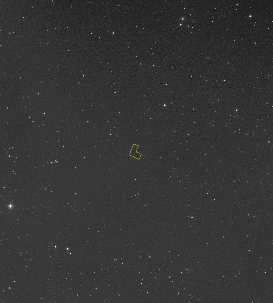
Hubble Deep Field location