One of the key aims of the astronomers who designed the Hubble Space Telescope was
to use its high optical resolution to study distant galaxies to a level of detail
that was not possible from the ground. Positioned above the atmosphere, Hubble avoids
atmospheric air glow allowing it to take more sensitive visible and ultraviolet light
images than can be obtained with seeing-limited ground-based telescopes (when good
adaptive optics correction becomes available in the visible, 10 m ground-based telescopes
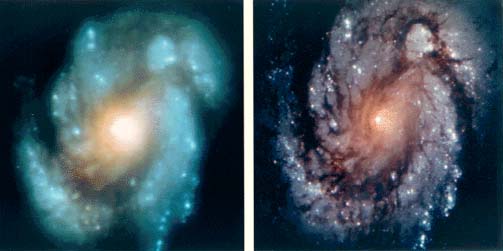
may become competitive). Although the telescope's mirror suffered from spherical
aberration when the telescope was launched in 1990, it could still be used to take
images of more distant galaxies than had previously been obtainable. Because light
takes billions of years to reach Earth from very distant galaxies, we see them as
they were billions of years ago; thus, extending the scope of such research to increasingly
distant galaxies allows a better understanding of how they evolve.
After the spherical aberration was corrected during Space Shuttle mission STS-61
in 1993, the now excellent imaging capabilities of the telescope were used to study
increasingly distant and faint galaxies. The Medium Deep Survey (MDS) used the WFPC2
to take deep images of random fields while other instruments were being used for
scheduled observations. At the same time, other dedicated programs focused on galaxies
that were already known through ground-based observation. All of these studies revealed
substantial differences between the properties of galaxies today and those that existed
several billion years ago.