





wpd551da0e.png
wpc86e7031.png
wp86b38b0b.png
wpc794f249.png
wp341b860f.png
wp87efa845.png
wp6ab78815.png

© 2007 Created by Goqa
wpf3ed59cf_0f.jpg
wp19e5bba0.png
wp8bcedfd5.png
wpaab25117.png
wpe5994fac.png
wp499995bf.png

Once a field had been selected, an observing strategy had to be developed. An important decision was to determine which filters the observations would use; WFPC2 is equipped with forty-eight filters, including narrowband filters isolating particular emission lines of astrophysical interest, and broadband filters useful for the study of the colours of stars and galaxies. The choice of filters to be used for the HDF depended on the 'throughput' of each filter— the total proportion of light that it allows through— and the spectral coverage available. Filters with bandpasses overlapping as little as possible were desirable.


In the end, four broadband filters were chosen, centred at wavelengths of 300 nm (near-ultraviolet), 450 nm (blue light), 606 nm (red light) and 814 nm (near-infrared). Because the quantum efficiency of Hubble's detectors is quite low at 300 nm, the noise in observations at this wavelength is primarily due to CCD noise rather than sky background; thus, these observations could be conducted at times when high background noise would have harmed the efficiency of observations in other passbands.


Images of the target area in the chosen filters were taken over ten consecutive days, during which Hubble orbited the Earth about 150 times. The total exposure times at each wavelength were 42.7 hours (300 nm), 33.5 hours (450 nm), 30.3 hours (606 nm) and 34.3 hours (814 nm), divided into 342 individual exposures to prevent significant damage to individual images by cosmic rays, which cause bright streaks to appear when they strike CCD detectors.
wp106e9aeb.png

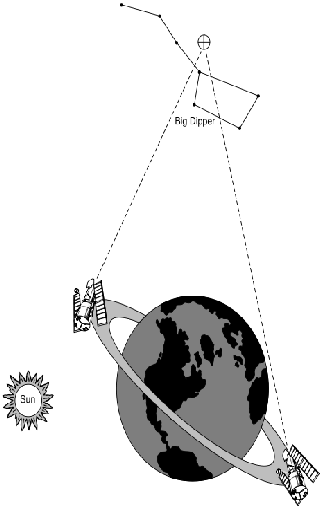
The HDF was located in Hubble's northern Continuous Viewing Zone, as shown by this diagram.