




© 2007 Created by Goqa



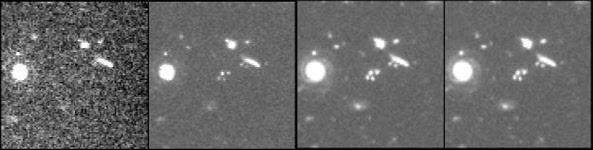
The production of a final combined image at each wavelength was a complex process. Bright pixels caused by cosmic ray impacts during exposures were removed by comparing exposures of equal length taken one after the other, and identifying pixels that were affected by cosmic rays in one exposure but not the other. Trails of space debris and artificial satellites were present in the original images, and were carefully removed.
Scattered light from the Earth was evident in about a quarter of the data frames. This was removed by taking an image affected by scattered light, aligning it with an unaffected image, and subtracting the unaffected image from the affected one. The resulting image was smoothed, and could then be subtracted from the bright frame. This procedure removed almost all of the scattered light from the affected images.
Once the 342 individual images were cleaned of cosmic-
The data processing yielded four monochrome images, one at each wavelength. The combining of these into the full colour images released to the public was a fairly arbitrary process, with one image designated as each of red, green and blue, and the three images combined to give a colour image. Because the wavelengths at which the images were taken do not correspond to the wavelengths of red, green and blue light, the colours in the final image only give an approximate representation of the actual colours of the galaxies in the image; the choice of filters for the HDF (and the majority of Hubble images) was primarily designed to maximize the scientific utility of the observations rather than to create colours corresponding to what the human eye would actually perceive.