






© 2007 Created by Goqa



The Hubble Deep Field (HDF) is an image of a small region in the constellation Ursa Major, based on the results of a series of observations by the Hubble Space Telescope. It covers an area 144 arc seconds across, equivalent in angular size to a tennis ball at a distance of 100 metres. The image was assembled from 342 separate exposures taken with the Space Telescope's Wide Field and Planetary Camera 2 over ten consecutive days between December 18 and December 28, 1995.
The field is so small that only a few foreground stars in the Milky Way lie within it; thus, almost all of the 3,000 objects in the image are galaxies, some of which are among the youngest and most distant known. By revealing such large numbers of very young galaxies, the HDF has become a landmark image in the study of the early universe, and it has been the source of almost 400 scientific papers since it was created.
Three years after the HDF observations were taken, a region in the south celestial hemisphere was imaged in a similar way and named the Hubble Deep Field South. The similarities between the two regions strengthened the belief that the universe is uniform over large scales and that the Earth occupies a typical region in the universe (the cosmological principle). In 2004 a deeper image, known as the Hubble Ultra Deep Field (HUDF), was constructed from a total of eleven days of observations. The HUDF image is the deepest (most sensitive) astronomical image ever made at visible wavelengths.
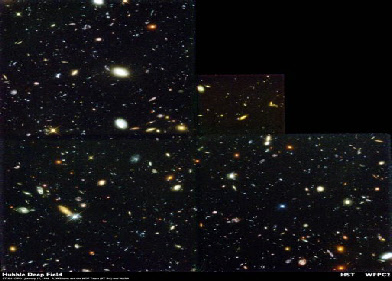
The Hubble Deep Field